History · the Mongol conquests
The Golden Horde: the Army That Rewrote the Map
How a nation of horsemen conquered more land in 25 years than Rome did in four centuries
The Iron Hooves Hymnal scores the moment Genghis Khan's armies rode off the steppe and into history. “The Golden Horde” isn't just an evocative album title — it's the real name history gave to one branch of that army, and for two and a half centuries it was the terror and the trade-broker of half a continent.
An empire built on discipline, not just horses
Mongol cavalry earned its reputation the hard way: composite bows that could outrange most infantry weapons, riders trained from childhood who could shoot at a full gallop, and — most decisively — Genghis Khan's decimal army structure, splitting every force into units of ten, a hundred, a thousand, and ten thousand, each promoted on merit rather than birth. A messenger network of relay riders (the yam) let orders and intelligence move faster than any rival empire could react. It was this machine, not raw numbers, that let the Mongols conquer roughly twice the land Rome ever held — in a fraction of the time.
The Horde that turned golden
After Genghis Khan's death, his empire split among his sons and grandsons. The western portion — the lands stretching from the Ural Mountains across the steppes of what is now Russia and Ukraine — fell to his grandson Batu Khan. Russian chronicles later called Batu's court the “Golden Horde,” likely for the color of its great ceremonial tent (Mongolian ordu simply means “camp” or “horde” — not the swarming rabble the English word now implies, but a formal royal encampment). From Sarai on the Volga, the Golden Horde ruled or taxed the Russian principalities for roughly 240 years — longer than the United States has existed.
Terror that also built roads
The conquest was genuinely brutal — cities that resisted, like Ryazan and Kiev, were destroyed as a deliberate warning to the next city down the road. But the empire that followed the conquest is remembered differently: the so-called Pax Mongolica made the Silk Road safer than it had been in centuries, letting merchants, missionaries, and ideas move from China to Europe under one loose umbrella of Mongol law. Marco Polo's journey to the Mongol court happened because that road, for one long century, was open.
The music it inspired
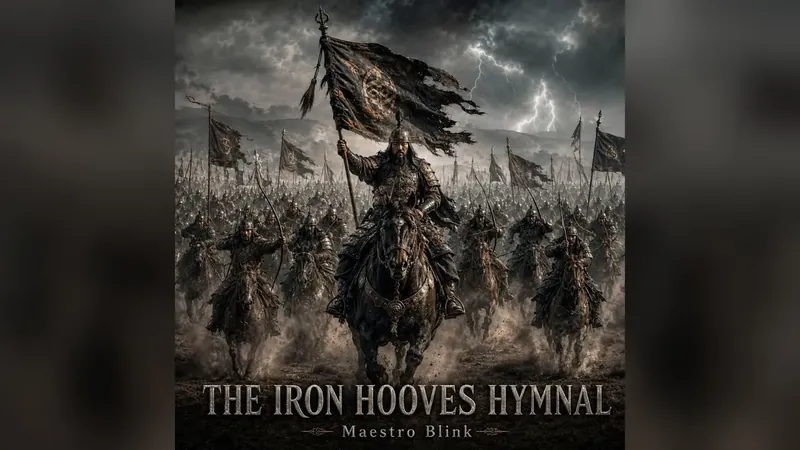
The Iron Hooves Hymnal
A million hooves shake the ground. The march of the Golden Horde, set to iron and thunder.
The march is the album: “Hooves of Thunder” opens the campaign at a full gallop, and “The Golden Horde” borrows the marching cadence of “The Battle Hymn of the Republic” — its chorus chants Aldar! (Алдар), Mongolian for “Glory,” over a wall of choir and church organ.