History & mythology · the Viking Age
The Seeress and the Eagle That May Never Have Flown
One woman who really did read the future — and one legendary punishment that probably never happened
Saga of the Winter Seas opens with a woman reading fate in the dark, and calls its second track after one of the most infamous — and most disputed — punishments ever attributed to the Viking Age. Between them sits the real, uneven line between what the sagas record and what they invented to make a better story.
The wand-carrier who was real
The völva — literally 'wand-carrier' or 'staff-bearer' — was a genuine and respected figure in Norse society, not a poetic invention. Practitioners of a form of magic called seiðr, they were often itinerant: a völva could travel between farmsteads, be given the seat of honor, and be paid to perform prophecy for a community, sometimes with a chorus of women singing a summoning chant called varðlokkur beside her. This isn't only literary — archaeologists have excavated völva burials furnished with an iron or wooden staff and, in the richest known example, the Oseberg ship burial, a pouch of cannabis seeds beside a hollow staff. The office survived vividly enough in memory that the single longest prophecy poem in the entire Poetic Edda, Völuspá ('The Prophecy of the Seeress'), is voiced entirely by one.
The eagle carved on a dying man's back
The blóðǫrn, or 'blood eagle,' appears in nine surviving medieval accounts: a captured enemy has his ribs severed from his spine and his lungs pulled out through the opening to resemble a spread eagle's wings — inflicted, in the sagas, as vengeance for a father's murder. It's a genuinely terrifying image, and for a long time it was treated as documented Viking cruelty. Modern historians are far less certain. Every account comes from Christian chroniclers or Icelandic sagas written two to three centuries after the events they describe, the details are often vague or physiologically implausible, and one leading theory holds that later poets may have misread an older, purely metaphorical verse — a dead man's ribs described as looking like an eagle's wings in the ordinary business of a battlefield corpse — and turned a figure of speech into a torture scene.
Two women, two different kinds of true
Put side by side, the two tracks make an honest album about how Viking-Age memory actually worked. The völva was a documented office with graves to prove it — a woman genuinely consulted for real prophecy. The blood eagle is, at best, unproven, and quite possibly a game of telephone across three centuries of Christian retelling. Both live equally well in the world of story. Only one of them is likely to have happened.
The music it inspired
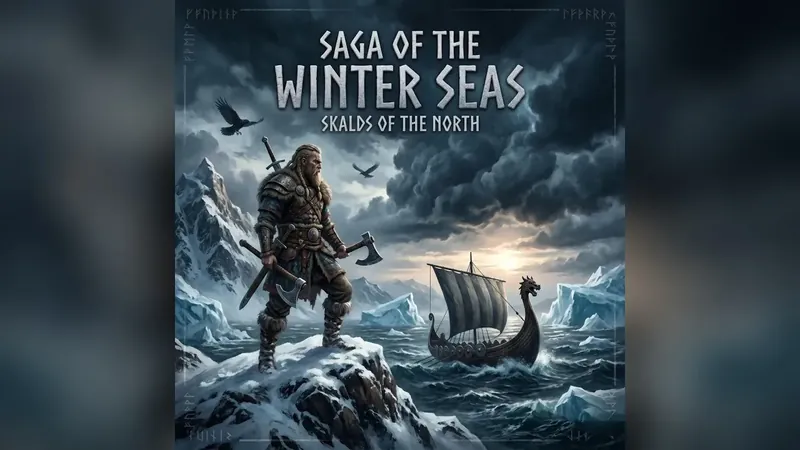
Saga of the Winter Seas
Forged in frost, sailing toward Valhalla. The blood eagle awakens on unknown shores.
The album opens with her: “Völva's Prophecy” has the seeress cast the runes and name the saga before a single sword is drawn — “I see the threads the Norns have spun... your saga begins with a funeral song.” Two tracks later, “The Blood Eagle Awakens” sends the warriors to the forge with that same prophecy ringing over the anvil.