History & belief · 13th-century Mongol Empire
The Sky That Chose a Khan
A shaman's word turned scattered tribes into an empire — and a buried thread finally ties their story to the North
Maestro Blink rides east this time. Tengri's Awakening and its sister albums aren't a costume change — they're the same cinematic engine, the same hunger for the sound of an empire being born, pointed at a different horizon: the 13th-century rise of the Mongol Empire, and the sky-god its founder claimed had chosen him.
A shaman's word, and an empire is born
In 1206, a chieftain named Temüjin summoned a kurultai — a great assembly of the Mongol tribes — on the banks of the Onon River. Nearly a million People of the Felt Walls are said to have gathered. Temüjin had spent two decades breaking and absorbing rival tribes — the Merkit, the Naiman, the Kerait, the Tatars — and at this kurultai the assembled chiefs raised him as sole ruler, with the title Genghis Khan (its exact meaning still debated — perhaps 'universal' or 'oceanic' ruler). He dismantled the old clan hierarchy on the spot, rebuilding the army as units of tens, hundreds, and thousands where promotion was earned, not inherited. A shaman named Teb Tengri stood beside the new Khan and declared him the chosen instrument of Möngke Köke Tengri — the Eternal Blue Sky. Legitimacy, in the Mongol world, came from heaven before it came from the sword.
The god who was the sky itself
Tengri was not a god who lived in the sky, the way Odin sits enthroned in Asgard. In Tengrism, the sky itself — vast, blue, unownable — was the divine force, paired with Etügen, the Mother Earth. There were no temples to Tengri; the steppe under an open sky was temple enough. Between this formless heaven and the human world stood the böö and udgan — shamans and shamanesses — who read omens, healed the sick, and, in Teb Tengri's case, made kings. It was a worldview carried in practice and ritual rather than scripture, and it gave Genghis Khan something a purely political claim never could: the sense that his conquests were not ambition, but destiny written above him.
When the two wolves finally met
Here is the part the fantasy version skips: the Vikings of longship and raid were centuries gone by the time Genghis Khan rode. Their age is usually bracketed 793 to 1066 — Temüjin wasn't even born until roughly a hundred years after Hastings. But their bloodline had not vanished; it had put down roots. In the 9th century, Norse traders and warriors known to the Slavs as Varangians — among them the semi-legendary Rurik — had founded the trading principality that became Kievan Rus'. For nearly four centuries their descendants ruled it. And in the winter of 1237 to 1240, the armies of Genghis Khan's heirs swept across those very lands, burning Ryazan, Vladimir, and finally, in December 1240, Kiev itself — a city the Rurikid dynasty, sons of the Norse Rurik, had ruled since the 9th century. The Viking who founded that realm and the Khan who ended it never stood on the same field. Their grandsons' grandsons did.
The music it inspired
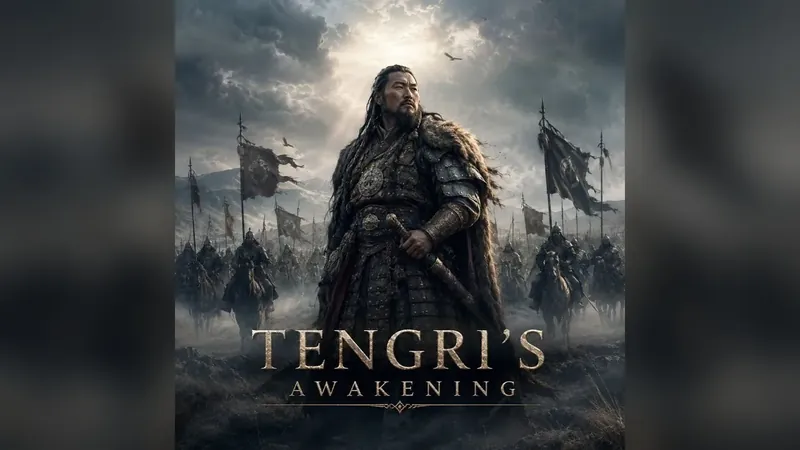
Tengri's Awakening
A mother's chant at the fire, then the horde rides at dawn. The Eternal Blue Sky answers in thunder.
One production, two horizons: this collection carries the same cinematic engine east across the steppe — “The Steppe's Whisper,” “Mother Oelun's Chant,” and “The First Arrow” open Tengri's Awakening; “The Golden Horde,” “Tengri Gates,” and “Unbreakable Khan” drive The Iron Hooves Hymnal; “Silk and Steel” and “Tengri's Will” ride through The Khan's Crusade; “The Khan's Vision” and “The Pax Mongolica” close The Eternal Legacy. And on Valkyries on the Steppe, the two worlds meet in a single title — “Valkyries of Tengri.”